

The idea of a spirit guide can feel comforting or difficult to define. Some people use the phrase for a benevolent spiritual presence. Others mean an ancestor, a meditation symbol, or a name for the wiser part of their intuition. These meanings can coexist in personal practice, but they are not interchangeable facts.
A grounded approach leaves room for spiritual belief while keeping your judgment active. You can notice an impression, write it down, and explore what it means to you without assuming that every dream, coincidence, or sudden thought came from an external source. The practice below is designed for reflection and discernment. It does not promise contact or provide a way to verify a supernatural claim.
What Do People Mean by “Spirit Guide”?
The contemporary spirit-guide concept has roots in several streams of Western esoteric thought. Reference works connect its modern use with the nineteenth-century Spiritualist movement and later New Age spirituality. In Spiritualism, some believers describe particular spirits as guides. Spiritism, a related tradition organized around the writings of Allan Kardec, developed its own teachings about spirits, mediumship, and reincarnation.
The phrase now appears far beyond formal Spiritualist communities. A person may use it for:
- a spiritual being believed to offer guidance;
- an ancestor or deceased loved one remembered as a source of wisdom;
- a symbolic teacher encountered in prayer, dreams, or meditation;
- an image that helps a person access intuition and personal values;
- a creative framework for reflection.
This broad modern usage deserves care. Guardian angels and archangels, ancestors, saints, deities, and spirit guides belong to different theological and cultural frameworks. Name the tradition or personal framework you are using, and avoid borrowing a sacred practice without context.
For background, see the historical overviews of Spiritualism and Spiritism. These sources describe movements and beliefs; they do not establish that spirit communication has been scientifically verified.
Before You Begin: Choose a Clear Purpose
Start with a modest purpose such as understanding a feeling, clarifying a value, or considering your next ordinary step. Questions that demand a prediction often increase anxiety and encourage selective interpretation. Questions about your own choices are easier to examine responsibly.
Useful prompts include:
- What value do I want to express in this situation?
- What detail have I been avoiding?
- Which option supports honesty, patience, and care?
- What small action can I take and review later?
Avoid handing over major decisions to an impression. Health, legal, financial, and safety questions require qualified advice and verifiable information. Spiritual reflection may help you organize your thoughts, but it cannot replace those sources.
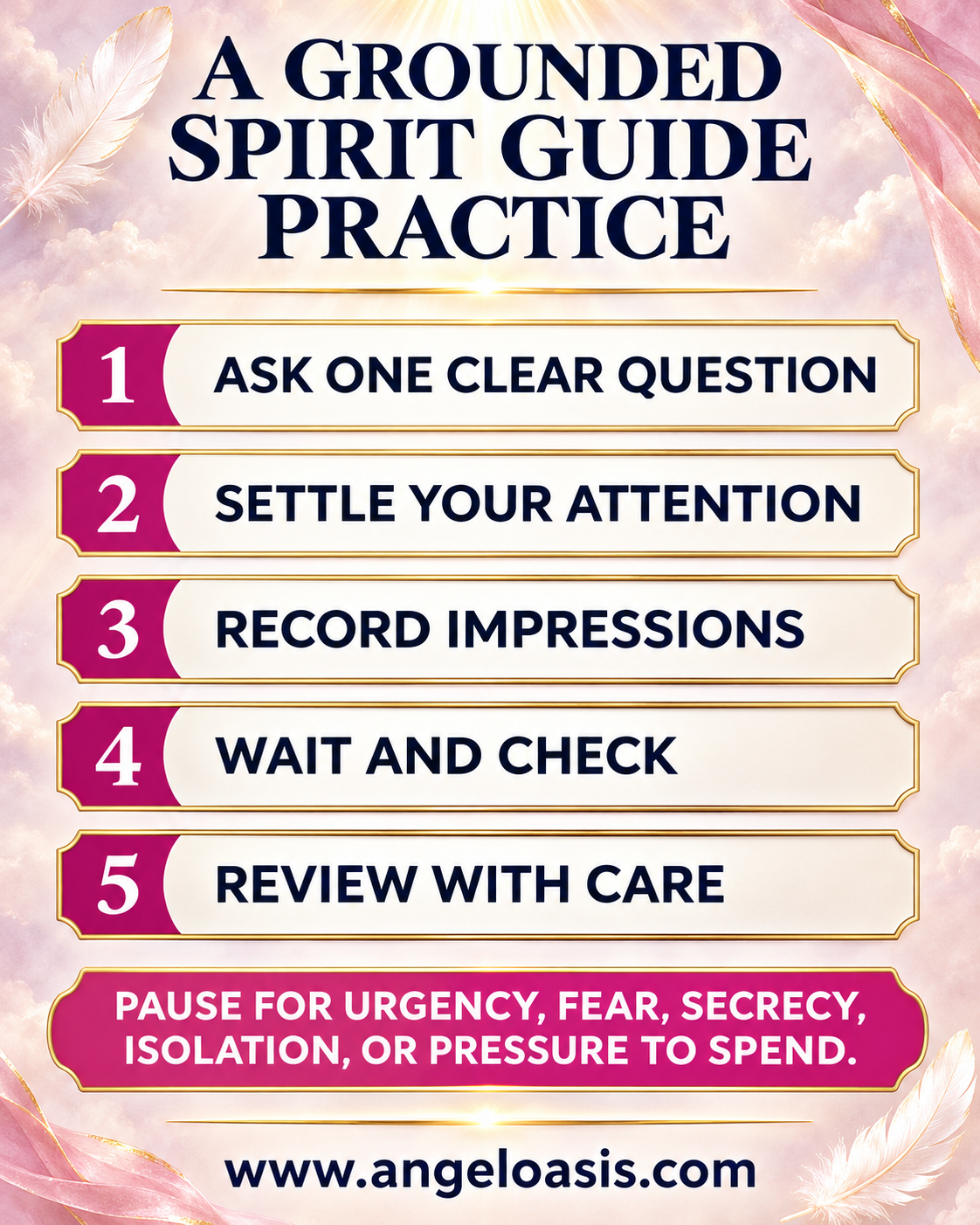
A Five-Step Practice for Connecting With Spirit Guides
You can complete this practice in ten to fifteen minutes. A quiet room may help, although candles, cards, crystals, and special tools are optional.
1. Ask One Specific Question
Write one question at the top of a page. Keep it focused on your conduct or perspective. “How can I approach this conversation with more compassion?” gives you something practical to review. “What will definitely happen?” invites certainty that the exercise cannot provide.
2. Settle Your Attention
Take several slow breaths, say a familiar prayer, or notice physical sensations such as your feet on the floor. Let your body become calmer before you interpret anything. If you feel rushed, frightened, or intensely activated, pause and return later.
The goal is to create a little space around the question before interpreting an impression.
3. Record Impressions in Neutral Language
For two or three minutes, write any words, memories, images, emotions, or physical sensations that arise. Describe the experience before assigning it a cause.
Neutral: “I remembered the blue notebook my grandmother used.”
Interpretive: “My grandmother sent the notebook as a command.”
The neutral version preserves what happened. You can explore its personal meaning afterward without turning the first explanation into a conclusion.
4. Wait and Check Ordinary Explanations
Leave the entry alone for several hours or a full day. When you return, ask what else could explain it. A repeated image may relate to a recent conversation, a worry, an advertisement, a familiar habit, or something you hope will happen. Finding an ordinary explanation does not make the reflection useless. It may reveal what already has your attention.
Also notice how often you encounter information that does not fit your expectation. Recording both matches and non-matches reduces the tendency to remember only the details that confirm a preferred interpretation.
5. Review the Message Against Values and Evidence
Ask whether the impression supports compassion, responsibility, consent, and practical reality. Look for evidence outside the exercise before making a consequential choice. A helpful reflection can become a small, reversible action: ask a respectful question, make a plan, gather information, or rest before deciding.
If the impression requires urgency, secrecy, isolation, large spending, or harm, do not act on it. Speak with someone trustworthy and use the discernment checklist below.
Spirit Guide Signs, Patterns, and Uncertainty
People commonly describe dreams, recurring themes, meaningful coincidences, sudden calm, inner phrases, or symbolic images as possible spirit-guide signs. These experiences can feel powerful. Their meaning remains personal and uncertain.
Consider a song lyric that appears during a stressful week. You might experience it as timely encouragement. You might also hear it because the song is popular, because an algorithm repeated it, or because your attention is tuned to that topic. You can appreciate the moment while keeping those explanations open.
The same approach works with dreams. Write the dream down, notice the emotions it evokes, and ask how its themes relate to your current life. Avoid treating a dream as a literal instruction. A symbol can prompt a useful question without becoming proof of an external message.
Patterns become more informative when you record them consistently. A journal lets you compare the original entry with later events instead of rewriting the memory after the outcome is known. Research on journaling finds possible benefits in some contexts, but results vary and no single method works for everyone. A systematic review and meta-analysis of journaling offers a useful evidence-based overview of those limits.
A Discernment Checklist
Pause the exercise and seek outside perspective when an impression:
- creates intense fear or pressure to act immediately;
- demands secrecy from people you normally trust;
- tells you to isolate yourself or end supportive relationships;
- pressures you to send money, buy access, or pay for repeated “clearing” services;
- gives medical, legal, financial, or safety instructions;
- flatters you as uniquely chosen while dismissing all disagreement;
- encourages harm, revenge, coercion, or disregard for another person’s consent;
- grows stronger when you are sleep-deprived, using substances, or under severe stress.
Use a simple three-part review: Is it kind? Is it safe? Is it supported by ordinary evidence? A spiritually meaningful idea can still wait while you verify facts and consult qualified people.
Hearing or seeing things that others do not can have many causes and deserves compassionate, professional attention, especially when it is new, distressing, or worsening. The NHS guidance on hallucinations and hearing voices advises getting medical help and seeking emergency assistance if voices direct someone to harm themselves or another person. In the United States, SAMHSA advises calling or texting 988 for crisis support, or calling 911 when someone is in immediate danger.
A Seven-Day Spirit Guide Journal
Use one row each day. Keep entries brief and review them at the end of the week.
| Day | Question | Impression recorded neutrally | Ordinary explanation | Small action considered | Later review |
|---|---|---|---|---|---|
| 1 | |||||
| 2 | |||||
| 3 | |||||
| 4 | |||||
| 5 | |||||
| 6 | |||||
| 7 |
At the end of seven days, look for themes rather than dramatic predictions. Which questions keep returning? Which impressions align with your values? Which entries had clear ordinary explanations? Which actions helped, and which felt unwise after a pause? The review matters more than the number of signs you recorded.
Frequently Asked Questions
Are Spirit Guides and Guardian Angels the Same?
They may overlap in an individual’s personal vocabulary, but the terms come from different belief frameworks. Guardian angels are usually understood through angelic theology. Spirit-guide language has a broader modern history connected with Spiritualism, esoteric thought, and personal spirituality. Use the term that accurately reflects your own tradition and respect how other communities define theirs.
How Can I Tell Intuition From Anxiety or Wishful Thinking?
No quick test can settle every case. Slow the process down. Record the impression, name the emotion present, list at least two alternative explanations, and wait before acting. Anxiety often pushes toward urgency and repeated checking. Wishful thinking may ignore inconvenient facts. A sound decision can tolerate questions, evidence, and advice from trustworthy people.
Do I Need Meditation, Cards, Crystals, or Candles?
No special object is required. Some people use a meaningful item to signal the beginning of quiet reflection. Others prefer a notebook and a few calm breaths. Choose tools that support attention without becoming a source of pressure, dependency, or expensive promises.
What If an Impression Feels Frightening or Urgent?
Stop the exercise. Ground yourself in the room, contact someone you trust, and do not follow instructions that could cause harm. If you hear voices, see things others do not, feel unable to stay safe, or are considering harm to yourself or someone else, seek urgent professional support. In the United States, call or text 988; call 911 for immediate danger.
Can I Ask a Spirit Guide to Predict My Future?
You can write any question in a personal journal, but a reflective exercise cannot reliably predict an outcome. Focus on choices within your control, the information available now, and the kind of person you want to be while uncertainty remains.
Keep Curiosity and Discernment Together
A spirit-guide practice can offer a language for reflection, comfort, and meaning. Its value grows when curiosity travels with patience, cultural respect, and reality-based checks. Record what you experience, stay open to more than one explanation, and choose small actions that remain consistent with your values and safety. If this practice is part of a wider period of change, our guide to a spiritual journey offers a broader framework for reflection.
If you prefer a specifically angelic framework, compare this routine with our daily practices for connecting with your guardian angel.
The most useful outcome may be a clearer understanding of your own attention: what you fear, what you hope for, and what deserves a thoughtful next step.