

Uriel is a Hebrew name commonly interpreted as “God is my light,” “light of God” or “fire of God.” The angel appears in ancient works such as 1 Enoch and 2 Esdras and in later Jewish and Christian traditions. His roles vary across those sources.
If this symbol of wisdom interests you, start with the name and the texts. They offer a richer introduction than a fixed ranking of angels or a promise that prayer will bring an immediate answer.
Reviewed and updated October 11, 2026
Uriel Name Meaning: A Hebrew Name of Light
The name comes from Hebrew, rather than Ancient Greek. The ending El refers to God. English reference works give several related translations for the full name, including “God is my light” and “flame of God.” The NET Bible’s collected dictionary entries show these variations.
Light and fire give the name a shared theme of illumination. However, a name meaning is not a complete biography. It does not establish every role that later writers assign to the angel.
Uriel is also a human name in biblical passages, including Chronicles. A reference to someone with this name should not automatically be read as a reference to the angel. The context tells you which figure the passage describes.
Where Does Angel Uriel Appear?
Uriel in the Book of Enoch
In 1 Enoch 20:2, Uriel is listed among the holy angels and given a role concerning the world and Tartarus. The text belongs to ancient Jewish apocalyptic literature. Its visions explore divine order, judgment and the heavens.
The Book of Enoch has an important place in the Ethiopian Orthodox Tewahedo canon. It is not part of most Jewish and Christian biblical canons. Whether that work counts as biblical scripture depends on the collection and tradition being discussed.
Another role appears in 1 Enoch 10:1–3, in R. H. Charles’ translation. God sends Uriel to warn Noah, the son of Lamech, about the coming flood and to explain how his line may survive. Here Uriel is the messenger, while Noah is the human recipient. The relationship also fits Genesis 5:28–29, which names Noah as Lamech’s son.
Uriel and the Prophet Ezra in 2 Esdras
2 Esdras 4:1 names Uriel as the angel sent to answer Ezra. The dialogue concerns difficult questions about suffering, justice and the limits of human understanding. The work’s central Ezra apocalypse is also known as 4 Ezra.
This role helps explain the later association with instruction and wisdom. It is a particular literary role. It should not be turned into a promise that every person who prays will receive an unmistakable answer.
Uriel in Different Christian Traditions
Christian communities use different texts and forms of devotion. The Orthodox Church in America’s account of the heavenly powers includes Uriel and describes him through the themes of divine light and enlightenment. It also discusses traditional icon imagery.
Roman Catholic teaching takes a different approach to naming angels. The Directory on Popular Piety, paragraph 217, allows the names Michael, Gabriel and Raphael because they occur in Catholic Scripture. The Catholic canon includes Tobit, where Raphael appears, but not 1 Enoch or 2 Esdras. Uriel’s place in another Christian tradition should therefore be described in that tradition’s own context.
An angel should also be distinguished from the Holy Spirit in Christian theology. The Catechism, paragraphs 327–330, describes angels as created spiritual beings. Paragraph 689 describes the Holy Spirit as divine. Shared imagery of light or fire does not make Uriel another name for the Holy Spirit.
You may encounter Uriel described as a fourth archangel in a particular list. That is not a universal ranking of spiritual power. Lists and roles differ, so name the source rather than presenting one numbered place as universal.
Light, Fire and Uriel’s Symbols
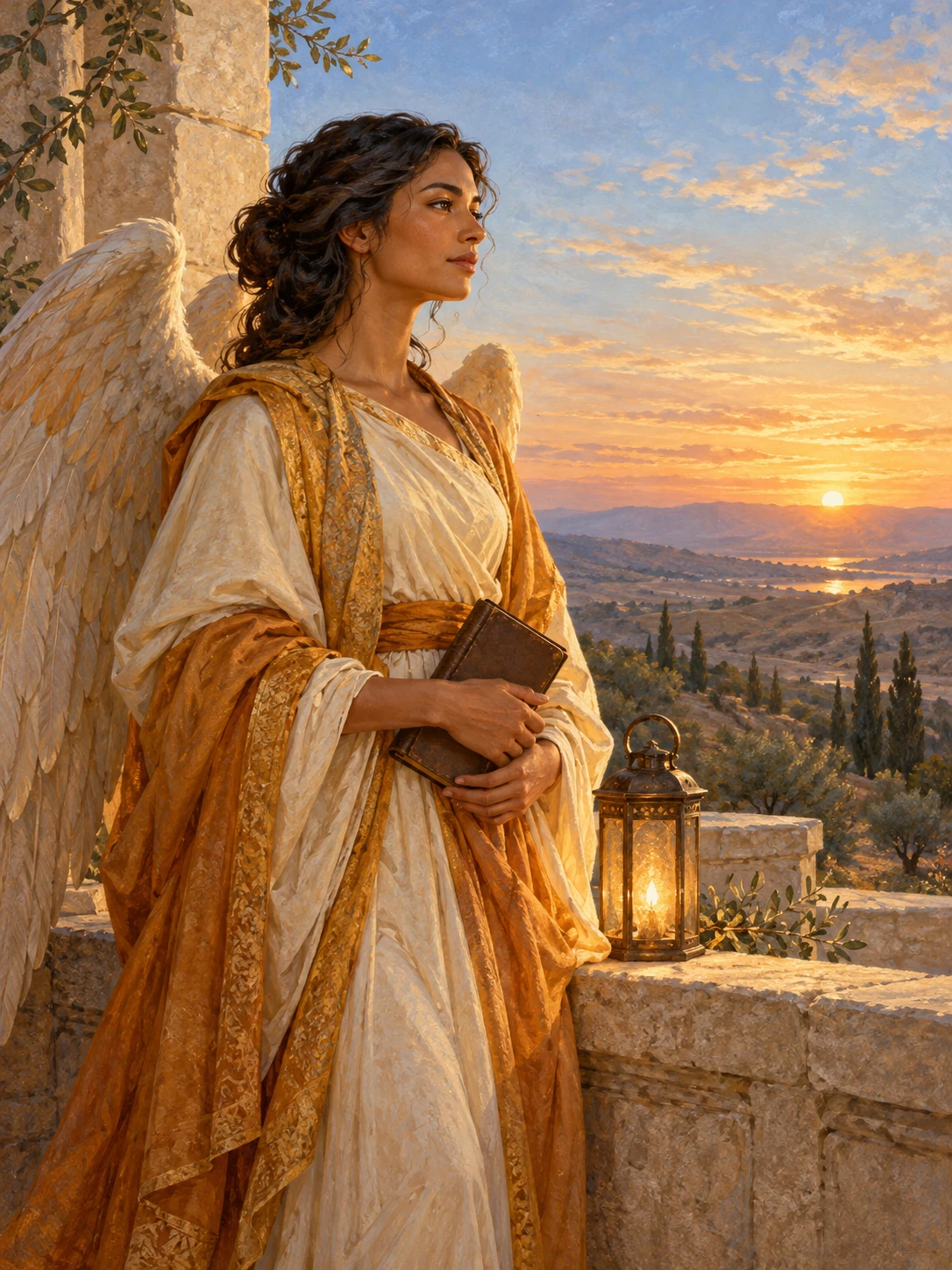
Light and fire reflect the familiar meanings of the name. The Orthodox Church in America describes an icon with a sword and a flame. Other artistic portrayals may emphasize a book or a scroll to suggest instruction.
An image tells you something about an artist’s tradition and choices. It does not establish an angel’s physical appearance. Modern color associations can also vary; there is no need to treat one color as a universal identifying signal.
You might value a moment of insight after reading or prayer. That can be meaningful without proving supernatural contact. Ask what became clearer and what still needs checking. A helpful insight should leave room for facts, other people’s views and ordinary explanations.
How to Reflect on Wisdom with Uriel
This original Angel Oasis exercise uses illumination as a theme for a practical decision. It is not an ancient ritual.
- Name one question. Write it in a sentence. Keep it specific enough that you can take a useful next step.
- Separate facts from guesses. List what you know and what you are assuming.
- Find the missing information. Decide whether you need to read, ask someone a question or give the situation more time.
- Pray or pause. Ask for patience, honesty and a willingness to learn.
- Choose one action. Gather a fact, have a conversation or make a small start.
For example, if you are unsure whether to take a class, write down its cost, timing and subject. Then note what you hope to gain and what you still need to ask. A reflective practice can help you pay attention; checking the details helps you decide.
Students, teachers and creative people may find the symbolism of light encouraging. It can remind you to work steadily and stay curious. You do not need to interpret every coincidence as guidance or wait for a sign before using your judgment.
An Original Prayer Inspired by Uriel
This contemporary prayer was written for Angel Oasis. It is addressed to God and draws on the themes of light and wisdom.
God of light, help me see this situation with patience and honesty. May the image of Uriel remind me to seek understanding, listen carefully and admit what I do not know. Give me courage to ask a useful question and wisdom to take a thoughtful next step. Let what I learn lead me toward kindness and responsible action. Amen.
You may adapt these words to your beliefs. No special object or repeated formula is required. Quiet reflection can be worthwhile even when no unusual experience follows.
Common Questions About Uriel
What does Uriel mean?
Common English interpretations include “God is my light,” “light of God” and “fire of God.” The name is Hebrew.
Is Uriel mentioned in the Bible?
The angel is named in 1 Enoch and 2 Esdras, whose place varies across biblical collections. Human figures called Uriel also appear in Chronicles. Read each passage in context.
What is Uriel known for?
Ancient accounts portray different roles, including answering Ezra and explaining divine mysteries. Later devotion often emphasizes light, instruction and wisdom.
Is Uriel always the fourth archangel?
No single numbered ranking is shared by every source or community. A description of Uriel as fourth should identify the particular list.
How can I explore Uriel without searching for signs?
Read a relevant passage, consider its tradition and use a simple reflection if helpful. Our guardian angel communication guide offers further ideas for a regular practice.
Sources and Further Reading
- NET Bible — Uriel dictionary entries and Hebrew name
- 1 Enoch 20, Charles translation
- 2 Esdras 4:1, Bible Gateway
- Orthodox Church in America — Synaxis of the Heavenly Powers
- Vatican — Directory on Popular Piety, paragraph 217
For distinct traditions and roles, explore Archangel Michael, Archangel Raphael and Archangel Metatron.