

A tarot spread is a layout in which each card position answers a particular part of your question. The positions give a reading structure: the same card can offer a different reflection when it represents your situation, a challenge, or a next step. You do not need a complicated arrangement to begin. Choose the fewest cards that let you explore your question clearly.
Below are eight useful tarot spreads, including three variations on the familiar three-card layout. Treat them as tools for reflection and spiritual exploration. A possible outcome is an interpretation of a direction, rather than a fixed promise.
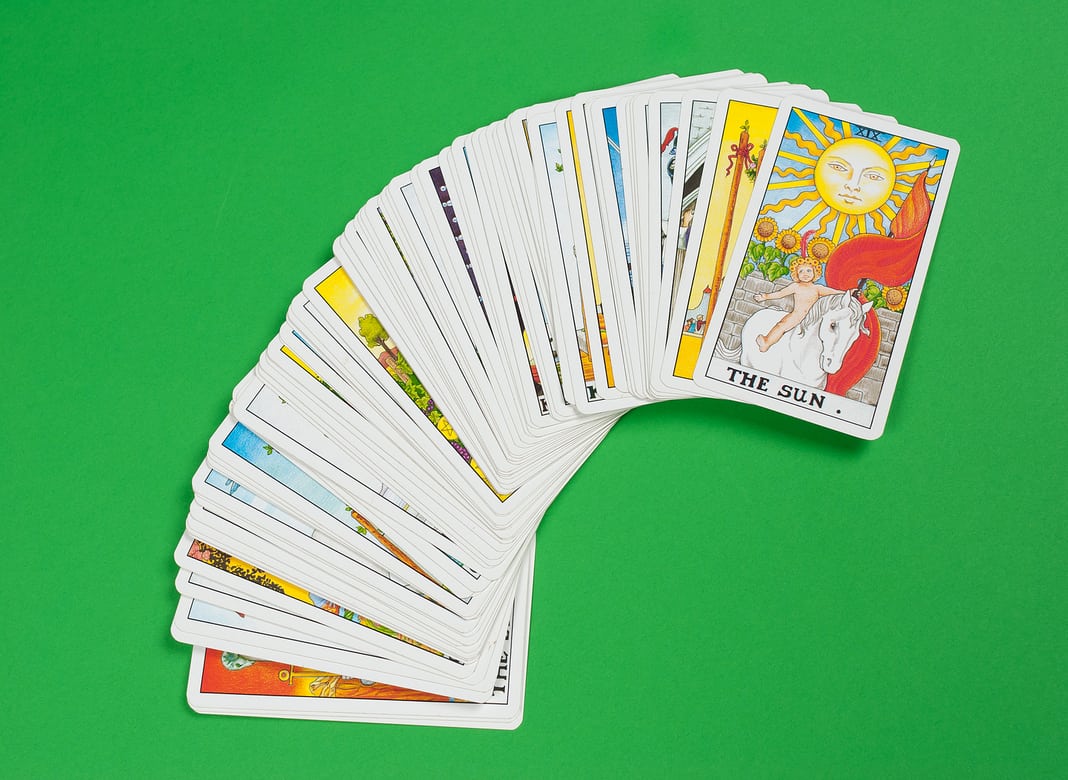
Which Tarot Spread Should You Choose?
| Spread | Cards | Best for | Avoid when |
|---|---|---|---|
| One card | 1 | One daily focus | You need to compare options |
| Three cards | 3 | A sequence or next step | Several separate issues compete |
| Five-card cross | 5 | Connected influences | You feel overwhelmed |
| Decision or relationship | 5 | A specific choice or dynamic | You want certainty about someone else |
| Celtic Cross | 10 | A detailed overview | You are learning basic positions |
Start with the question, then choose the layout. “What can I do differently this week?” needs less space than a question involving competing responsibilities, expectations, and long-term plans. If you feel anxious, pause before drawing. More cards can produce more material to interpret without making your question clearer.

1. One-Card Focus
Ask, “What deserves my attention today?” Draw one card and identify one image, one theme, and one action. A card associated with patience might become an invitation to slow down before responding to a difficult message.
This is a useful beginner tarot spread because you can practice connecting symbolism with everyday experience. Write your interpretation before consulting a guide, then compare it with the traditional tarot card meanings. Keep the action small enough to try today.
2. Past, Present, Possible Direction
Place three cards from left to right:
- Past: an influence you bring into the situation.
- Present: what deserves attention now.
- Possible direction: a pattern to explore as circumstances develop.
Ask, “How has this situation developed, and what can I learn from its direction?” Compare the first and third cards through the middle card. You are building a story, rather than treating three images as unrelated messages. To practice this format, try our free three-card tarot reading.
3. Situation, Action, Likely Outcome
This three-card tarot spread shifts attention toward what you can do.
- Situation: the central issue.
- Action: a response worth considering.
- Likely outcome: a possible consequence of that response.
Ask, “How can I approach this challenge constructively?” Read the last card in relation to the action card. If the combination feels uncomfortable, examine what adjustment might help. The layout does not establish what will happen; its value is in making your choices easier to discuss and evaluate.
4. Mind, Body, Spirit
Use three positions for a gentle personal check-in: your thoughts, your physical needs, and your sense of meaning or connection. Ask, “Where can I bring more balance into my day?”
Interpret the body position as a prompt about everyday care, such as rest or pacing. It cannot diagnose a condition. Look for tension between positions: your mind might want to keep pushing while your body needs a break. Finish with an action that respects both.
5. Five-Card Cross
For several connected influences, place the situation card in the center. Put the challenge to its left, a helpful influence above, practical advice below, and a possible outcome to the right.
- Situation: what you are exploring.
- Challenge: what makes it difficult.
- Helpful influence: a resource or strength.
- Practical advice: something you can try.
- Possible outcome: a direction to consider.
Give each position a distinct job. “Challenge” and “what is blocking me” would largely repeat each other. Compare the challenge with the helpful influence before interpreting the outcome.
6. Five-Card Decision Spread
Arrange five cards in a row: what matters, path A, path B, missing information, and a decision principle. Name both paths before shuffling so that you apply the same question to each option.
For example, compare “start a small pilot now” with “wait until my current project ends.” The missing-information position can prompt a practical check, such as your available time. The final card helps you articulate a value to prioritize. Make your decision using real information alongside your reflection.
7. Five-Card Relationship Spread
Try these positions: your perspective, their perspective, the shared dynamic, a communication need, and a constructive next step. Ask, “How can I contribute to a clearer conversation?”
Their-perspective cards are possibilities to explore, not evidence of another person’s private thoughts. If an interpretation suggests distance, ask what you have actually observed and what remains an assumption. The most useful relationship tarot spreads end with something within your control: an honest question, a boundary, or an invitation to listen.
8. Celtic Cross
The Celtic Cross uses ten cards, usually arranged as a six-card cross with a four-card column beside it. Practitioners use different numbering conventions, so choose one guide and write down its positions before drawing.
One established version explores the present, challenge, past, near future, conscious focus, underlying influences, your approach, external influences, hopes and fears, and a possible outcome. These positions are interpretive lenses, rather than verified facts about hidden motives.
Choose this spread when you have time to examine several layers of one situation and feel comfortable connecting cards. Learn a three-card reading first if the larger layout leaves you juggling ten separate definitions.
How to Read the Cards Together
First interpret each card through its assigned position. Then notice repetition, contrast, and progression. Several cards emphasizing effort might suggest that your interpretation needs a practical focus. A contrast between rest and activity may invite a discussion about timing.
Connect the positions in one sentence: “Because the situation involves ___, I can try ___ while remaining aware of ___.” If you cannot connect the cards, return to the question. You do not need to force every image into a dramatic message.
An Illustrative Three-Card Reading
Question: “How should I approach a second project without neglecting my current commitments?” This is an invented teaching example, not a reported draw.
- Situation — Two of Pentacles: its traditional balancing theme prompts you to examine competing demands. List your existing commitments before adding another.
- Action — Eight of Pentacles: its theme of focused practice suggests starting with a defined piece of work. Try a limited pilot with a clear time allowance.
- Likely outcome — Temperance: its associations with moderation and integration invite a sustainable pace, rather than a guarantee of success.
The synthesis might be: “I can explore the new idea through a small, scheduled pilot while protecting my existing responsibilities.” A practical next step is to reserve two short sessions and decide what you will review afterward. The interpretation becomes useful when it produces a manageable experiment in your actual life.
Try This: Question, Scope, Spread, Synthesis
- Write one open question about your own choices.
- Circle its distinct parts: context, options, support, or action.
- Assign a separate position to each necessary part.
- Draw and interpret those positions individually.
- Finish with one connected sentence and one practical action.
Record the question, cards, interpretation, and action in a journal. Later, review what helped you think more clearly, rather than searching only for events that appear to confirm the reading.
Common Tarot Spread Mistakes
Avoid adding cards whenever you feel uncertain, changing position meanings halfway through, and redrawing until an answer feels pleasing. These habits make it harder to compare interpretations fairly. Vague or repeated questions also create confusion. Write the question and positions first, keep the layout manageable, and allow an unclear card to remain a question for reflection.
Questions About Tarot Spreads
What is the easiest spread for beginners?
A one-card focus is a simple starting point. Move to three cards when you want to practice connecting positions.
How many cards should a spread use?
Use as many as your question needs. One, three, and five cards are useful starting sizes; ten cards offer more detail.
Can you create your own tarot spread?
Yes. Define each position before drawing and check that every position adds a different perspective.
What if a card does not fit its position?
Revisit the question, consider another traditional meaning, and note the uncertainty. You can return later without drawing extra cards.
Are tarot outcomes fixed?
No tarot interpretation establishes a fixed future. Your choices, other people, and changing circumstances remain part of the picture.
Continue Your Spiritual Reflection
Begin with a thoughtful question and a small spread. Let practice build familiarity, and use your notes to turn reflection into considered action. If guardian angel exploration is also part of your spiritual practice, you can take the Angel Oasis guardian angel quiz.
Practice references: Tarot.com’s introductory reading guide and Tina Gong’s Celtic Cross guide. Layouts and card meanings describe practitioner traditions. The exercise and project example above are original teaching material.