

Finding a yellow feather can feel bright and surprising. In modern spiritual writing, yellow is often associated with joy, optimism, curiosity, warmth, and mental clarity. Those associations can be useful reflection prompts, especially when the feather appears during a time of change or uncertainty.
They are not a fixed code. A feather does not prove that an angel or a deceased loved one sent a message, and it cannot predict luck, money, romance, or healing. Its most useful meaning may come from the meeting point between the real object, the moment in which you noticed it, and the personal response it awakened.
This guide helps you explore that response without losing sight of nature, evidence, or your own judgment.
What Does a Yellow Feather Mean?
A yellow feather commonly suggests joy, attention, hope, creativity, and a return of energy in modern symbolic interpretation. You might treat it as an invitation to notice what is becoming clearer, what deserves a more hopeful approach, or what small action could bring warmth back into your day.
The meaning changes with context. A feather found outside a hospital may stir a different response than one found beside a sketchbook, on a difficult walk, or after a conversation with a friend. Your first association matters because symbols work through memory and attention as much as through shared cultural ideas.
Try asking:
- What was I thinking about when I noticed the feather?
- Did yellow feel cheerful, urgent, peaceful, or unusual to me?
- Is there a situation where I need more information rather than a quick answer?
- What small, realistic action would express hope today?
These questions turn the experience into reflection. They do not require you to decide that the feather came from a supernatural source.
Common Yellow Feather Symbolism
Joy and optimism
Yellow is widely linked with sunlight and brightness, so a yellow feather can remind you to make room for ordinary forms of joy. This does not mean that a problem will disappear. It may simply suggest looking for one source of support, pleasure, or possibility that you have overlooked.
A practical response could be taking a short walk, calling someone who steadies you, or returning to an activity that makes you feel engaged.
Clearer attention
A vivid color naturally catches the eye. Symbolically, that can make a yellow feather a prompt to focus. If several demands are competing for your attention, write down the next decision that actually needs to be made. Separate it from questions that can wait.
Clarity often comes from gathering facts, naming constraints, and choosing a next step. The feather does not supply the answer; it can remind you to create the conditions in which a better answer becomes possible.
Curiosity and learning
Yellow can also suggest curiosity. A feather may invite you to ask what kind of bird it came from, why the color appears, or what you can learn about the place where you found it. This meaning turns a spiritual moment toward observation rather than certainty.
If the feather renews your interest in a neglected subject, follow that interest for fifteen minutes. Read, sketch, take notes, or ask a better question. Curiosity is valuable even when it does not lead to a dramatic conclusion.
Warmth and connection
Some people experience yellow as friendly and social. If that fits your response, the feather might become a reminder to offer warmth deliberately. Send a kind message, thank someone, or repair a small misunderstanding.
Connection still requires consent, timing, and honest communication. A symbol should never be used to assume what another person feels or to justify pursuing someone who has asked for space.
Why Are Some Feathers Yellow?
Before interpreting a feather, it helps to remember that color has a natural explanation. The Cornell Lab of Ornithology explains that bird colors come from pigments, feather structure, or a combination of both. Carotenoids, which birds obtain through their diet, produce many bright yellow, orange, and red colors. They contribute to the yellow plumage seen in birds such as goldfinches and Yellow Warblers.
Color alone usually cannot identify a species. Light, wear, staining, age, feather position, and the way a feather is viewed can change its appearance. The same bird may also have feathers with several patterns and colors across its body.
If identification matters, note the feather’s approximate length, shape, pattern, location, and nearby bird activity. The U.S. Fish and Wildlife Service Feather Atlas lets you compare flight-feather scans and search by characteristics. Its identifications are not definitive unless a qualified expert confirms them.
For a clear introduction to the science of plumage, see the Cornell Lab’s guide to how birds make colorful feathers.
Yellow and Black Feather Meaning
A yellow-and-black feather can suggest a balance between openness and caution. Yellow may represent hope, attention, or creative energy, while black may suggest limits, the unknown, or the need to protect time and focus.
One grounded interpretation is: move forward, but check the conditions first. If you are considering a new commitment, look at both the opportunity and the cost. Ask what evidence supports your excitement, what boundary you need, and what would make the next step reversible.
This is a prompt, not a universal code. In nature, yellow and black may simply be the normal pattern of the bird.
Yellow and White Feather Meaning
Yellow and white can evoke warmth combined with openness. You might use that pairing to reflect on a fresh start that needs both enthusiasm and simplicity.
If life feels crowded, choose one task to complete and one unnecessary demand to release. A calm beginning is often more sustainable than a dramatic promise to change everything at once.
White feathers already carry their own broad symbolic associations in popular spiritual writing. When both colors appear together, keep the interpretation personal and proportional to the event.
Yellow and Gray Feather Meaning
Yellow and gray can hold optimism beside uncertainty. Gray may suggest complexity, patience, or incomplete information, while yellow draws attention to what remains possible.
This combination can be a useful prompt when you want an immediate answer but do not yet have enough evidence. List what you know, what you are assuming, and what you still need to learn. Hope and uncertainty can exist together.
Is a Yellow Feather a Sign From an Angel?
Some people understand feathers as angel signs, and a yellow feather may feel personally connected to encouragement, joy, or guidance. Others see it as a beautiful natural object that became meaningful because of the timing. Both responses can be held gently.
There is no reliable test that proves a feather was sent by an angel. If you choose a spiritual interpretation, let it support reflection rather than replace judgment. A healthy interpretation should not pressure you, frighten you, demand money, or tell you to ignore medical care, legal advice, safety concerns, or another person’s boundaries.
For a broader look at how people reflect on repeated symbols, see seven signs associated with guardian angels. Read such signs as possibilities for personal reflection, not as guaranteed communications.
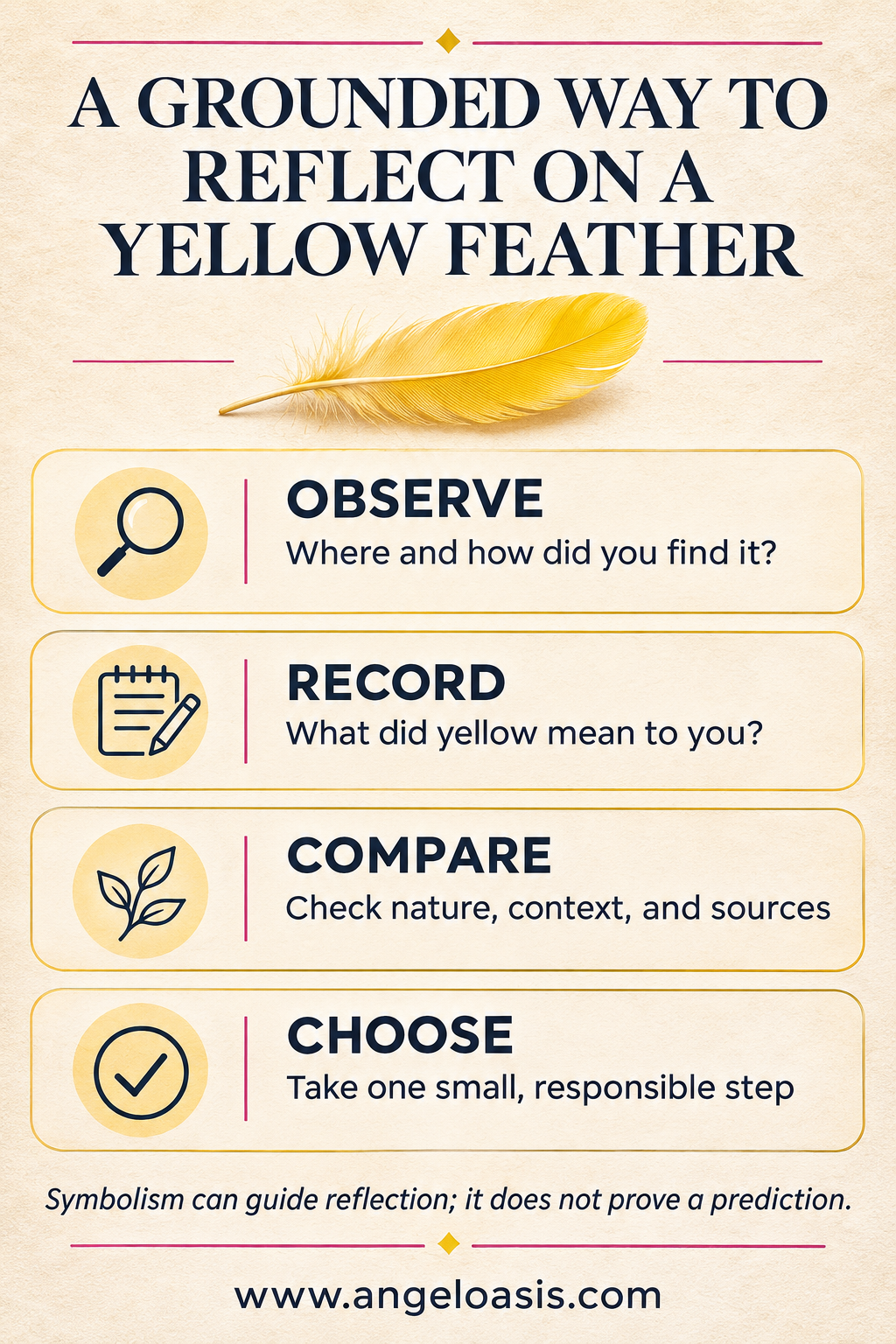
A Four-Step Way to Reflect on a Yellow Feather
1. Observe before interpreting
Notice where the feather is, whether birds are nearby, its size and pattern, and whether wind or human activity could have moved it. Take a photograph if you want a record, but avoid handling it until you understand local rules.
2. Record your first association
Write one or two sentences about what yellow means to you and what was happening when you found the feather. Capture your response before searching for dozens of interpretations. This helps you distinguish your own meaning from suggestions you encounter later.
3. Compare sources
Check a reliable bird source for the natural context. If you also consult spiritual sources, notice whether they describe a modern association, a personal practice, a religious teaching, or an unsupported historical claim. There is no single universal yellow-feather code shared by every culture or faith.
4. Choose one small action
Turn the reflection into a safe, proportionate step. You might gather information, make a neglected appointment, return to a creative project, thank someone, or spend ten quiet minutes journaling. The action should make sense even if the feather was a coincidence.
If you want to build a regular observation practice, the journaling suggestions in ten daily practices for connecting with your guardian angel can be adapted as a simple symbol-and-context journal.
Can You Keep a Yellow Feather in the United States?
Do not assume that a naturally molted feather is legal to keep. The U.S. Fish and Wildlife Service states that possessing feathers from native North American birds without a permit is prohibited under the Migratory Bird Treaty Act. The protection applies regardless of how the feather was obtained, and there is no general exemption for molted feathers or feathers from road- or window-killed birds.
There are specific exceptions and authorized routes, including rules for legally hunted gamebirds, permits for research or education, and provisions connected with federally recognized Tribes. State rules may also apply. If you are unsure of the species or the law, leave the feather where it is and use a photograph for reflection or identification.
Read the current U.S. Fish and Wildlife Service pages on feathers and the law and living around birds. This section provides general information, not legal advice.
What a Yellow Feather Does Not Guarantee
A yellow feather does not guarantee:
- good luck or a financial gain;
- a romantic reunion or a particular person’s feelings;
- physical or emotional healing;
- protection from harm;
- approval of a risky choice;
- a message from a deceased loved one; or
- a specific future event.
You can value the experience without making it carry more certainty than it can support. The most durable meaning is often the one that helps you observe carefully, think clearly, and act with kindness.
Frequently Asked Questions
Does a yellow feather mean good luck?
Yellow is often associated with hope and positive energy, so some people interpret the feather as encouraging. It does not predict luck. Use the hopeful feeling as motivation for a practical step rather than as evidence that an outcome is guaranteed.
What does finding a yellow feather on my path mean?
The setting can make the encounter feel timely. Notice what you were considering and what the feather brought to mind. Then check the natural context and choose an action that remains sensible without a supernatural explanation.
Does a yellow feather have a biblical meaning?
The Bible does not provide a universal color code assigning a specific message to a yellow feather. Biblical passages may use birds, wings, light, or gold in their own literary and theological contexts, but those should not be turned into a fixed yellow-feather prediction.
What if I keep seeing yellow feathers?
Repeated encounters may happen because of local birds, season, habitat, or increased attention after the first sighting. Keep a brief record of dates, places, conditions, and your response. A pattern can still be personally meaningful without proving a supernatural cause.
Should I pick up the feather?
In the United States, many native bird feathers are protected. Photograph it and leave it in place unless you can confirm that possession is authorized. Check current federal and state guidance when identification or handling matters.
A Grounded Closing Thought
A yellow feather can be both an ordinary part of a bird’s life and an unusual moment in yours. You do not have to choose between appreciation and critical thinking. Let the color invite joy, curiosity, or clearer attention. Observe the real world around it, respect the limits of interpretation, and carry forward one small action that adds warmth or understanding to your day.