

Moonstone, amazonite, amethyst and jade are four stones you can use as symbolic reminders during quiet reflection. In contemporary crystal practices, they are often associated with change, calm, contemplation or harmony. Those associations are beliefs, not evidence that a stone heals emotional distress.
If you are choosing an emotional stability crystal, use it as a personal reminder while caring for yourself in practical ways. A stone can be an object you enjoy holding or looking at while you journal, pray or pause. The reflection matters more than finding a supposedly perfect crystal.
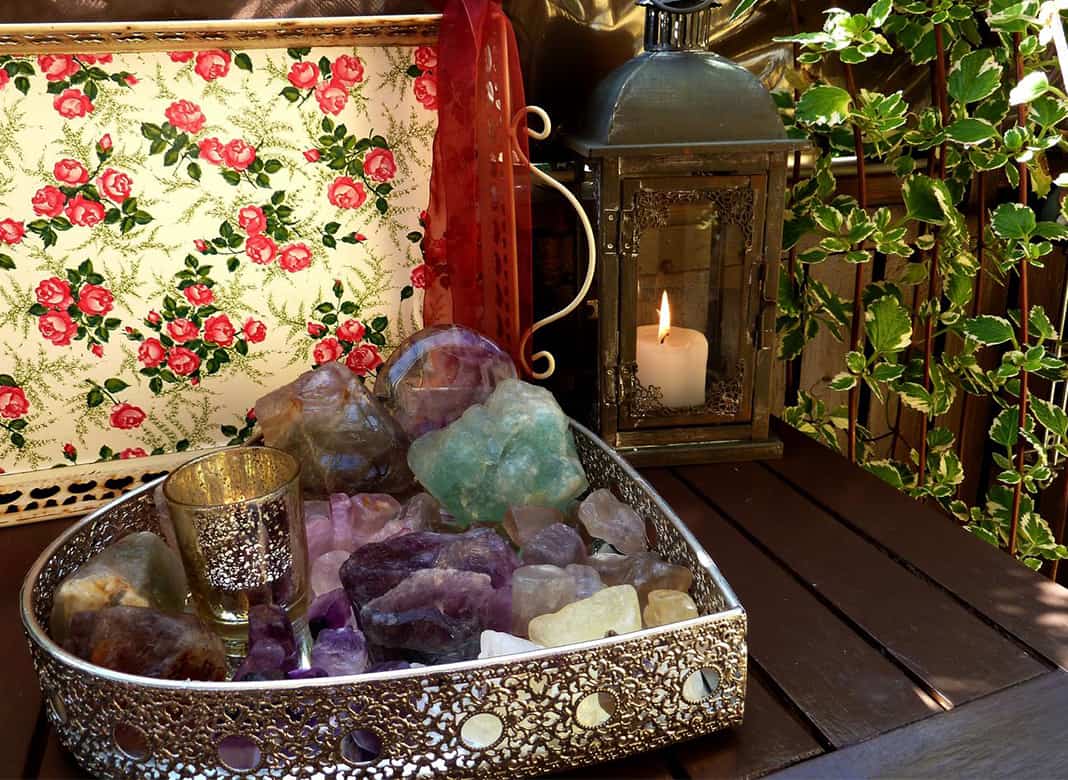
Do Crystals Help with Emotional Healing?
People use “emotional healing” to describe many experiences, including processing a disappointment, living with grief or learning to express feelings. A crystal cannot establish what support you need or promise to resolve those experiences.
A 2025 randomized study published in CNS Spectrums compared rose quartz with a visually similar placebo in 138 adults over two weeks. It found no specific anxiety-reducing benefit of the real crystal beyond the placebo. The study did not test all four stones in this guide, but it gives no basis for promising a therapeutic effect from a crystal.
You may still find meaning in a small ritual, a familiar object or a moment of attention. Describe that honestly as personal comfort or reflection. For ongoing anxiety, grief or distress, use appropriate support alongside any spiritual practice.
Four Stones and Ways to Reflect with Them
1. Moonstone: Making Space for Change
Moonstone is a feldspar gem known for a moving sheen called adularescence. The Gemological Institute of America explains that this appearance comes from light interacting with layers inside the stone, rather than the stone sharing the Moon’s physical powers.
In a symbolic practice, its changing appearance can remind you that you do not have to understand every feeling immediately. A transition may bring excitement and uncertainty at the same time.
Try this: Place the stone beside your journal and finish two sentences: “Something is changing in my life…” and “One thing I can keep steady is…”. Choose a realistic routine or source of support from your answer.
2. Amazonite: A Reminder to Communicate Clearly
Amazonite is a variety of microcline feldspar, as described in GIA’s overview of the feldspar family. Its familiar blue-green appearance makes it an attractive stone to keep on a desk or wear as jewelry.
Some contemporary crystal practices associate it with calm or communication. You can use that association as a prompt to consider what you want to say, without claiming that the mineral removes fear or controls negative thoughts.
Try this: Before a difficult conversation, write down what happened, how you felt and what you are asking for. Keep the request specific. “Could we agree on a time to talk?” is easier to respond to than expecting someone to guess what you need.
3. Amethyst: A Focus for Quiet Attention
Amethyst is purple quartz. Its color can range from pale lilac to deeper purple, with variations within a single crystal.
For personal reflection, you might let its appearance remind you to pause before responding or give yourself a few moments of quiet. That is an original reflective use, not a claim that amethyst treats anxiety, removes grief or changes a person’s energy field.
Try this: Look at the color and shape, notice what is around you, and name one feeling without judging it. Follow with one question: “What would be helpful right now?” The answer might be rest, company or asking for assistance.
4. Jade: Reflecting on Harmony and Patience
Jade is a gem name used for materials including jadeite and nephrite; it comes in more colors than green. GIA’s jade guide explains these material distinctions.
If you associate jade with harmony, consider what harmony means in your situation. It need not mean being happy all the time, agreeing with everyone or never feeling anger. It can mean making space for honest feelings while choosing a respectful response.
Try this: Ask, “Where do I need more patience, and where do I need a clearer boundary?” Write one small action for each. A meaningful object can remind you of your intention, but it cannot make that choice for you.
To choose between these four stones, start with the question you want to explore. You do not need to assign every feeling to a mineral. Pick one prompt for the situation in front of you, then decide on an action that you can carry out.
| Stone and reflection prompt | A practical next step |
|---|---|
| Moonstone: What has changed, and what can stay steady? | Choose one familiar routine to keep during a transition. |
| Amazonite: What would I like someone to understand? | Write one clear request before starting the conversation. |
| Amethyst: What am I feeling before I respond? | Write your first reaction, then choose what you want to say. |
| Jade: Where do patience and boundaries meet? | Describe what you can accept and what you need to decline. |
These are suggested uses for reflection. You can change them, use the same prompt with another object, or skip the object entirely.
Which Is the Best Crystal for Emotional Stability?
No stone has been established as the best treatment for emotional stability. If you want one for a personal practice, choose an object you like, can comfortably afford and will actually use. Its price or rarity does not determine the value of your reflection.
Rose quartz, smoky quartz and black tourmaline are other names you may encounter in crystal guides. You do not need to collect them or replace a stone because it supposedly has the wrong energy. The four examples above offer different prompts; none is a requirement for well-being.
Choosing a Stone That Fits Your Life and Budget
Separate two decisions: which reflection interests you, and which object is practical to use. You might like the moonstone prompt about change but prefer to keep a familiar pendant nearby. That is a reasonable combination. The meaning comes from the connection you choose, not a rule that one mineral must match one emotion.
Before considering a purchase, look at what you already have. Is there an intact stone or piece of jewelry that you enjoy? Can it sit somewhere convenient without getting knocked off a table? If you prefer not to handle an object, a photograph of it can serve as a visual cue. Choose the simplest option that fits your space.
If you do decide to shop, set a spending limit first and ask these questions:
- What is the material? Ask for the mineral name rather than relying only on a spiritual product name.
- Has it been treated? Request any known information about dyes, coatings or other treatments, plus care instructions.
- How will I use it? A display piece and a ring exposed to daily knocks have different practical demands.
- What am I paying for? Choose appearance or craftsmanship you enjoy, not a promise to remove distress.
Leave an item behind if the price or the responsibility of caring for it would add pressure. There is no need to buy a complete set, a larger specimen or a replacement to make the reflection valid.
How to Read Claims About Healing Crystals
A personal story and a treatment study answer different questions. “I felt calmer while holding this stone” describes someone’s experience. It does not establish that the mineral caused the change or that another person will have the same result. A useful question is: what was compared with what?
In the Cambridge study discussed above, the comparison was rose quartz versus a similar-looking placebo, not a crystal versus doing nothing. That distinction matters when judging claims of a special mineral effect. The researchers also identified limits: participants came from a nonclinical population, and the study concerned a short protocol. It should not be presented as a treatment trial in people with diagnosed anxiety disorders.
When reading a product description, separate a verifiable material fact from a symbolic association and a health promise. “Purple quartz” identifies a material. “A reminder of patience” describes a chosen meaning. “Treats anxiety” makes a medical claim and needs appropriate evidence. Scientific-sounding language alone does not supply that evidence.
Caring for the Object Without a Cleansing Ritual
Physical cleaning removes dirt; spiritual cleansing is a matter of belief. You do not have to expose a stone to heat, sunlight, salt or water to make it suitable for reflection. Care should follow its material and any treatments, not a promise about removing unwanted emotions.
GIA’s care guides show why one cleaning rule does not fit every gem:
- Moonstone: A hard knock can break it. GIA recommends warm, soapy water for cleaning and advises against steam and ultrasonic cleaners. Keep it away from high heat and sudden temperature changes.
- Amethyst: GIA recommends warm, soapy water as a safe cleaning method. Avoid steam and heat; prolonged intense light can fade some amethyst color. A sunny windowsill is not a necessary charging station.
- Jade: Its treatment history matters. Jade may be dyed, coated or otherwise treated. GIA identifies warm, soapy water as a safe cleaning choice, rather than assuming a method suitable for untreated jade fits every piece.
- Amazonite or an unidentified item: Do not assume that advice for another stone applies. If you lack reliable care instructions, leave it unwashed until you know what the material and finish require.
For jewelry, consider the whole item, including its setting and other materials, before choosing a cleaning method. Keep decorative stones out of food and drinking water. You can place the object nearby without putting it in your mouth, making a crystal drink or altering its surface.
A Simple Crystal Reflection for Daily Life
- Choose an intention: Name what you want to reflect on, such as patience, self-compassion or clear communication.
- Pause: Set the object nearby and give yourself a few quiet moments.
- Write: Describe one feeling and one need in ordinary language.
- Act: Choose a small helpful step, such as making a request or contacting someone supportive.
- Review: Notice whether the practice helps you reflect, rather than expecting the stone to produce a result.
If guardian angel devotion is part of your spiritual life, you can combine this reflection with your own prayer. Finding your guardian angel is a separate spiritual practice; it does not prove or amplify a stone’s healing ability.
A Worked Example: Feeling, Need and Action
Imagine that a friend has canceled a plan and you feel hurt. Instead of asking which crystal will remove the feeling, try three short journal entries:
- Feeling: “I feel disappointed and unsure whether our time together matters.”
- Need: “I would like clarity and a plan I can rely on.”
- Action: “I will ask whether we can choose another day.”
The feeling is your experience; it does not establish why your friend canceled. Your next message might be, “I was looking forward to seeing you. Would you like to choose another time?” If you keep amazonite nearby, let it remind you of that clear request. The conversation still depends on what you and your friend say and do.
A Seven-Day Journal Review
For a week, use one prompt rather than changing stones whenever your mood changes. Each day, write the situation, one feeling, one need and one action. Keep the entry brief enough to fit your routine.
On the seventh day, read the entries and underline actions you actually took. Which request became clearer? Which plan was realistic? Where did you need help rather than another private reflection? If you did not take an action, revise it into something smaller and more specific.
You might discover that the notebook mattered more than the stone, or that a particular prompt did not suit you. Keep what was useful and adjust the rest. Treat the review as a record of your choices, not a test of the crystal’s power.
When to Seek More Support
The National Institute of Mental Health recommends practical self-care such as sleep, manageable priorities and connection with supportive people. If emotional difficulties are persistent, distressing or disrupting daily life, speak with a qualified health professional. You can keep a meaningful spiritual practice while receiving appropriate care.
Sometimes the useful decision is to stop looking for an object and ask for help. NIMH advises seeking professional help for severe or distressing symptoms lasting two weeks or more, including trouble sleeping, concentrating or completing usual activities. This is not a requirement to wait two weeks before raising a concern. If you are worried about your mental health, a primary care provider can help you identify appropriate next steps.
Questions About Crystals and Emotional Healing
Can a crystal cure anxiety or grief?
No cure should be promised. A stone can be a personal symbol, while anxiety or grief may need support from trusted people and qualified professionals.
Do I need to create a crystal grid?
No. A crystal grid is an arrangement used in some spiritual practices. You can enjoy it as a symbolic display, but it is not required for reflection and has not been established as a treatment.
What does “clearing negative energy” mean?
In crystal writing, this is spiritual language. If you want to release negative feelings, name the feeling before choosing your next step. For a grounded practice, describe the feeling or situation you want to address, such as tension after an argument, and choose a helpful action rather than treating it as a measured energy field.
Can I do the reflection without buying a stone?
Yes. A notebook, a photograph or a familiar object can serve as a reminder of your intention. Personal care does not depend on a purchase.
What do “healing properties” and “soothing energy” mean?
In crystal healing guides, these phrases express spiritual associations or personal impressions. The same applies to descriptions such as calming properties. Here, emotional balance means making room for feelings while choosing a thoughtful response. A stone is a reminder for reflection rather than a treatment. It cannot guarantee emotional calmness or resolve emotional wounds; those experiences deserve care that fits the actual situation.
Can I wear my chosen crystal as jewelry?
Necklaces and bracelets are convenient ways to keep a chosen stone nearby. You do not need to believe that wearing it keeps crystal energies close. Use the jewelry as a reminder of your intention: when you notice it, name how you feel and choose one helpful next step. Wearing it does not establish a protective energy field or increase a stone’s healing power.
What about the heart chakra and emotional reflection?
AURA AURA’s color guide links the heart chakra with green, love and personal growth. If that framework fits your beliefs, a green stone can be a reminder to practice self-compassion. This symbolic exercise does not show that a crystal has repaired a chakra.